Exploring seaweed-derived materials, visible-light photochemistry and the science behind volumetric 3D printing.
By Elizabeth H. Challoner, MSc | SeaCo Designs | November 2026
At SeaCo Designs, a question that started with seaweed-based materials has gradually turned into something involving molecular photochemistry, computational modelling, light absorption, polymer networks and rather more chemistry than I originally anticipated.
But that is one of the things I love about materials research. You start with what sounds like a relatively simple idea, ask one question, and suddenly discover another ten questions hiding behind it.
Our latest research paper, Computational Screening of Bio-Sourced Photoinitiator Systems for Agarose-Based Computed Axial Lithography at 405–470 nm, explores one of those questions:
Could naturally derived, light-sensitive compounds help us develop new material systems for volumetric 3D printing?
The paper brings together published photochemistry, computational investigations and polymer science to examine what might be possible, what remains uncertain and what needs to happen next.
And, perhaps most importantly, it explores why making a material respond to light is considerably more complicated than simply shining a projector at it.
First, what is volumetric 3D printing?
Most people are familiar with 3D printing as a process that builds an object one layer at a time.
Computed Axial Lithography, or CAL, approaches the problem differently.
Instead of constructing an object layer by layer, CAL uses a sequence of calculated light projections delivered into a volume of photosensitive material. The light distributions combine to produce a three-dimensional exposure pattern, potentially allowing selected regions of the material to solidify.
It is a fascinating manufacturing approach because it changes how we think about creating three-dimensional structures.
However, the process depends on much more than the projector itself.
For CAL to work, light must travel through the material, interact with its chemistry and produce a sufficiently controlled response in the regions intended to become the finished object.
This raises a particularly interesting challenge when investigating naturally derived polymers.
Could naturally occurring compounds help?
One area of the research focuses on two compounds: curcumin and riboflavin.
Curcumin is best known as the principal yellow pigment associated with turmeric. Riboflavin is vitamin B₂.
Neither is a new discovery, and both have established scientific literature describing their interactions with light.
What makes them interesting for this investigation is their ability to absorb wavelengths within the visible spectrum and participate in photochemical processes.
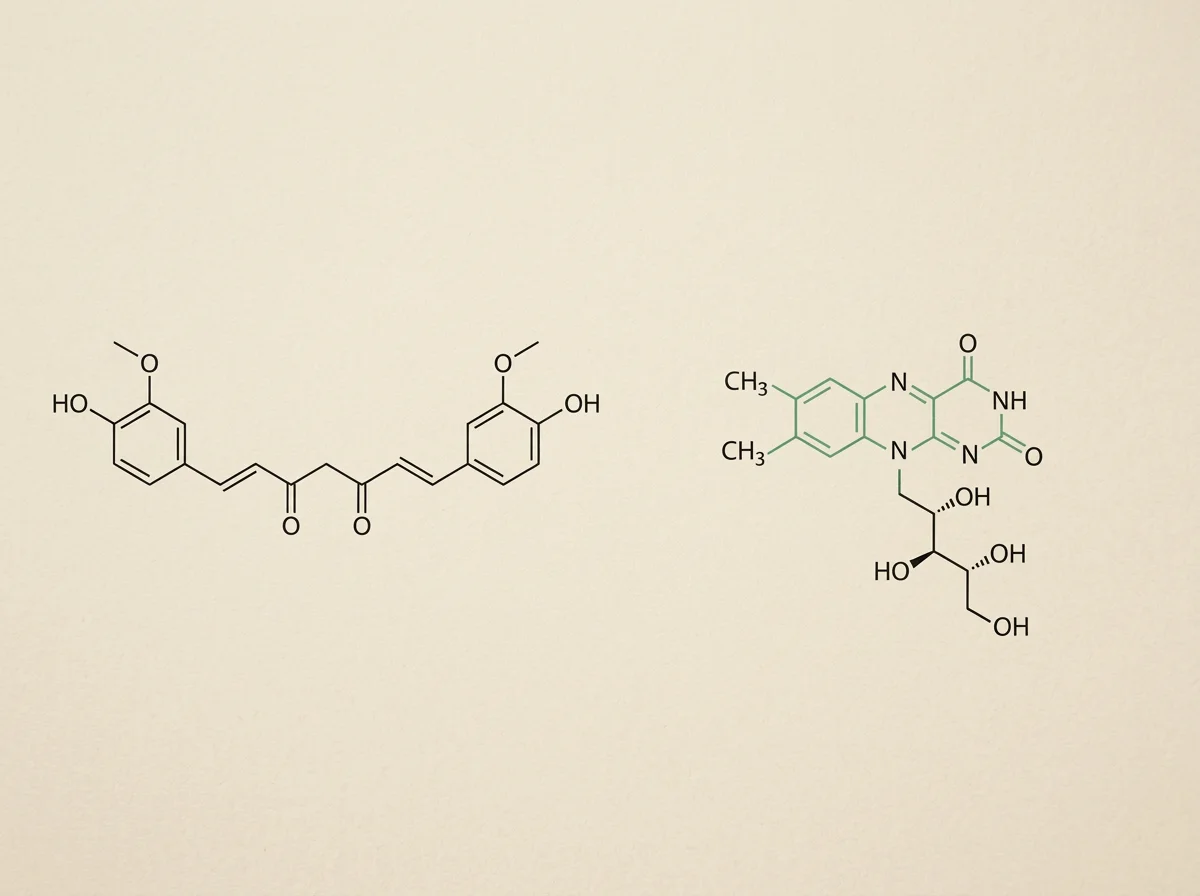
Figure 1 - The molecular structures of curcumin and riboflavin, highlighting the chromophore systems responsible for their light-absorbing behaviour.
When a molecule absorbs light of a suitable wavelength, its electronic state can change. Depending on its molecular structure and surrounding chemical environment, this excited state may undergo several different processes.
Some of these processes can contribute to the formation of reactive chemical species, including radicals involved in certain polymerisation reactions.
But there is an important distinction.
A compound that absorbs light is not automatically an effective photoinitiator.
Its performance depends on the surrounding chemistry, the availability of suitable reaction partners, oxygen, light intensity and the material in which it is being used.
That distinction became one of the central themes of the research.
The problem with absorbing too much light
You might reasonably assume that a material which absorbs light very effectively would be ideal for light-based 3D printing.
Unfortunately, it is not quite that simple.
Imagine shining a torch through a transparent container. If the contents absorb very little light, the beam can travel relatively far through the material.
If the contents absorb strongly, more of the light is captured near the surface, leaving less available to reach deeper regions.
In CAL, that creates a balancing problem.
We need sufficient absorption to initiate useful photochemistry, but we also need light to reach the regions required to form the intended three-dimensional geometry.
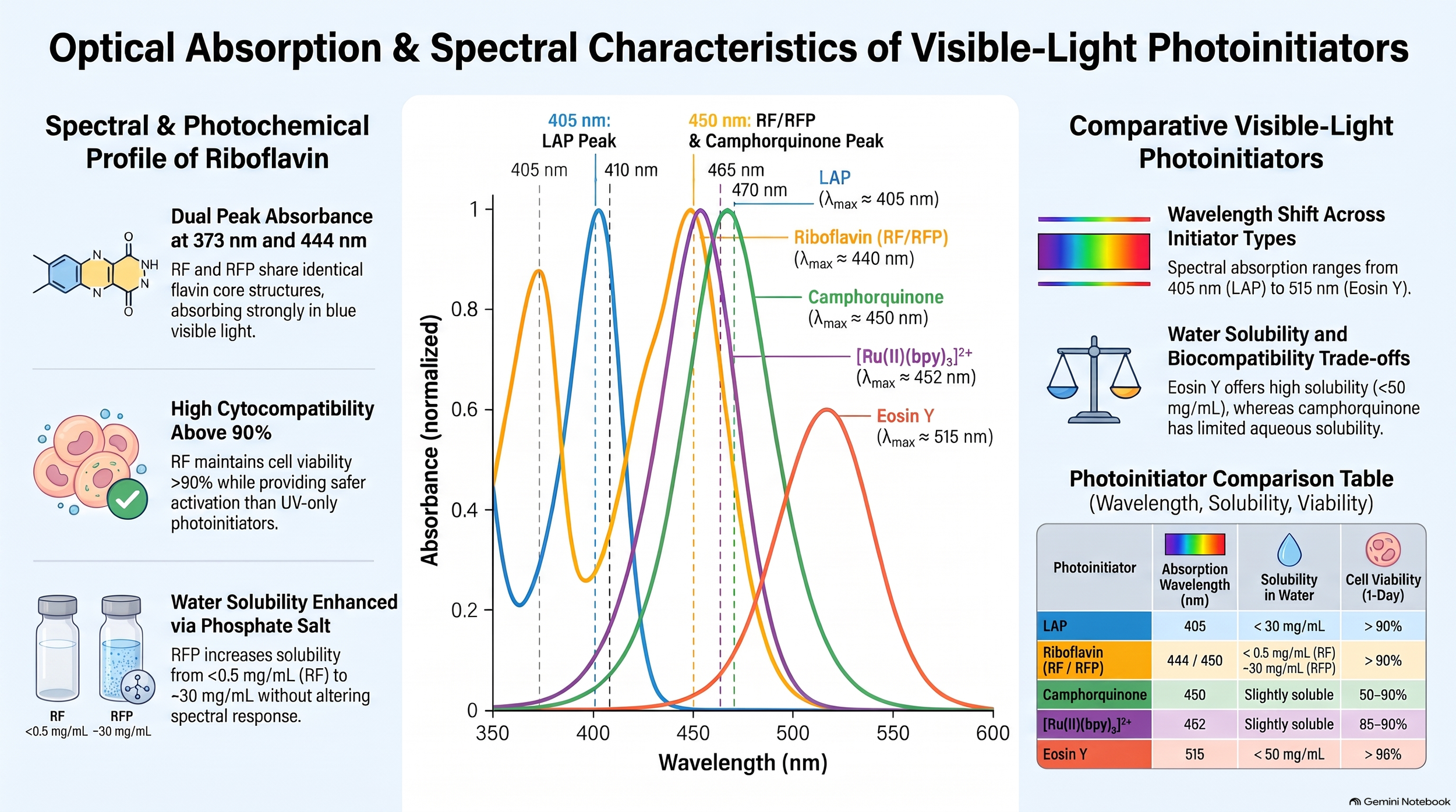
Figure 2 - A comparison of the wavelength-dependent absorption characteristics considered in the research, illustrating why the choice of illumination wavelength matters.
My paper examines this relationship across the 405–470 nm wavelength range, using literature-informed comparisons and computational models.
The modelling explores how light transmission changes with material absorption, optical path length and wavelength.
One of the most important conclusions is that stronger absorption does not necessarily mean better volumetric printing performance.
The useful response depends on how optical absorption interacts with the complete chemical system.
What happens to light inside a material?
To explore this further, I developed a series of computational investigations examining optical attenuation and transmission.
Put simply, optical attenuation describes how the intensity of light decreases as it travels through a material.
This matters because the light reaching one region of a printing volume may be different from the light reaching another.
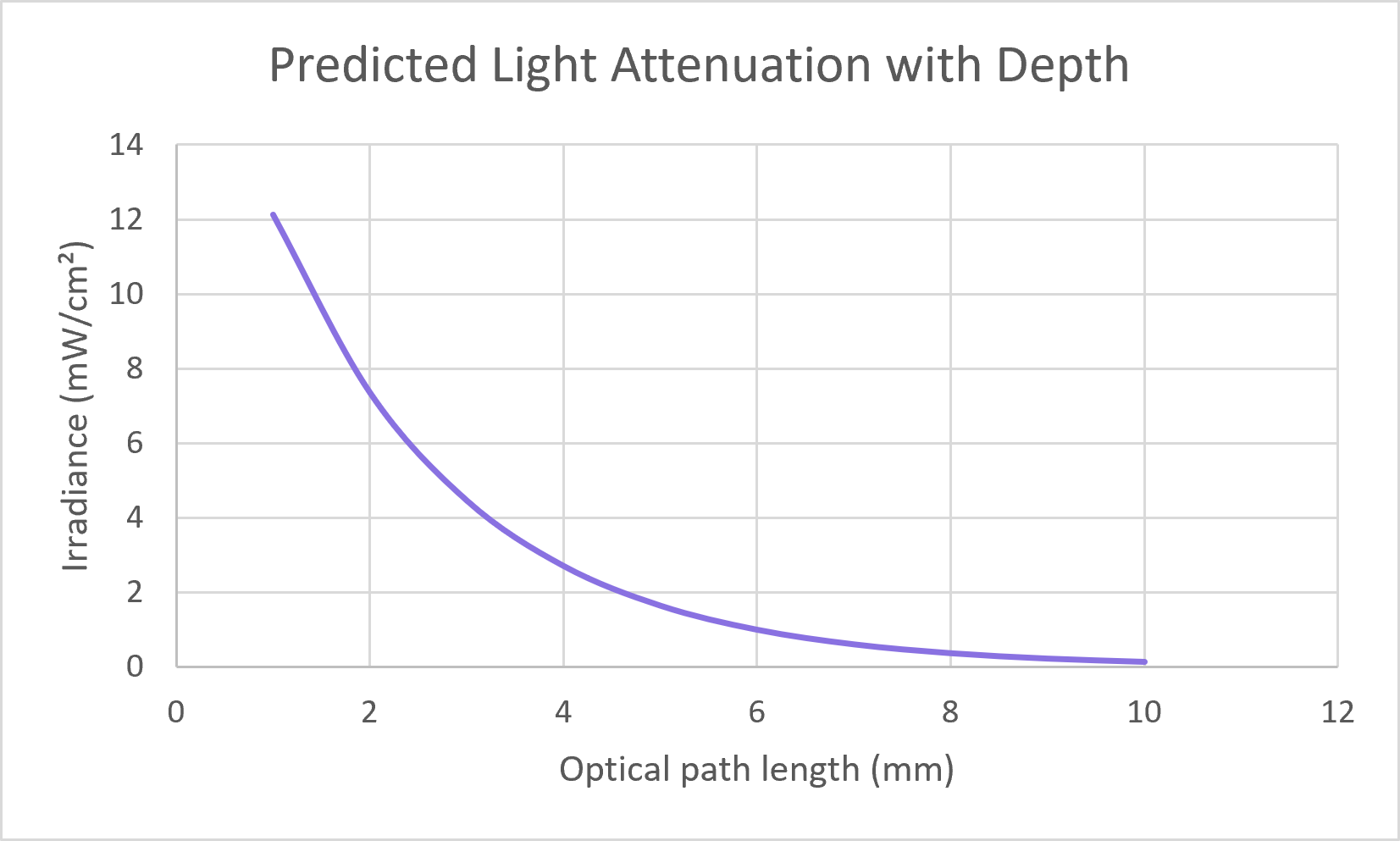
Figure 3 - An illustrative computational model showing how transmitted light intensity changes with depth in an absorbing medium. The results describe theoretical optical behaviour rather than experimentally measured SeaCo material properties.
The purpose of this modelling was not to claim that a finished material had already been developed.
Instead, it was to understand which relationships matter, where potential limitations may arise and what measurements would eventually be needed to test the predictions.
This distinction is particularly important in early-stage materials research.
A mathematical model can help us investigate what might happen under particular assumptions. It cannot, on its own, prove that a material will behave that way in a laboratory.
An unexpected complication: photobleaching
Another interesting part of the investigation concerns photobleaching.
Some light-sensitive compounds undergo chemical changes during illumination that alter how strongly they absorb light.
This means the optical properties of a material may not remain constant throughout exposure.
A material could begin by absorbing light strongly and subsequently become more transparent as its photosensitiser changes.
For volumetric printing, this creates an intriguing possibility: light penetration may evolve during the printing process.
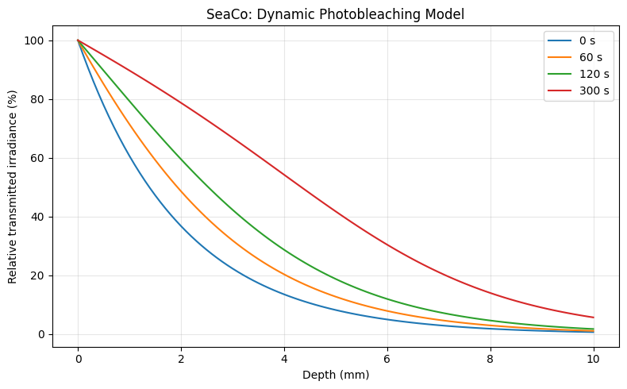
Figure 4 - An illustrative model examining how optical transmission may evolve during exposure when photosensitiser depletion changes the material's absorption behaviour.
However, photobleaching is not automatically beneficial.
If the chemistry changes too quickly, or in an uncontrolled way, it could complicate the distribution of light and the resulting material response.
The challenge is understanding the relationship between changing optical properties and the chemical reactions taking place.
It is another example of why light-based manufacturing requires us to consider chemistry, optics and processing conditions together.
And where does the seaweed come in?
The broader motivation behind this work is SeaCo's investigation into marine-derived materials.
One of the polymers of particular interest is agarose, a polysaccharide associated with red seaweed.
Agarose is well known for its ability to form gels. When prepared under suitable conditions and cooled, its polymer chains can organise into a hydrated physical network.
This is useful material behaviour, but it introduces a major scientific question for CAL.
Agarose can form a gel when cooled. Does that mean it can be selectively solidified using light?
Not necessarily.
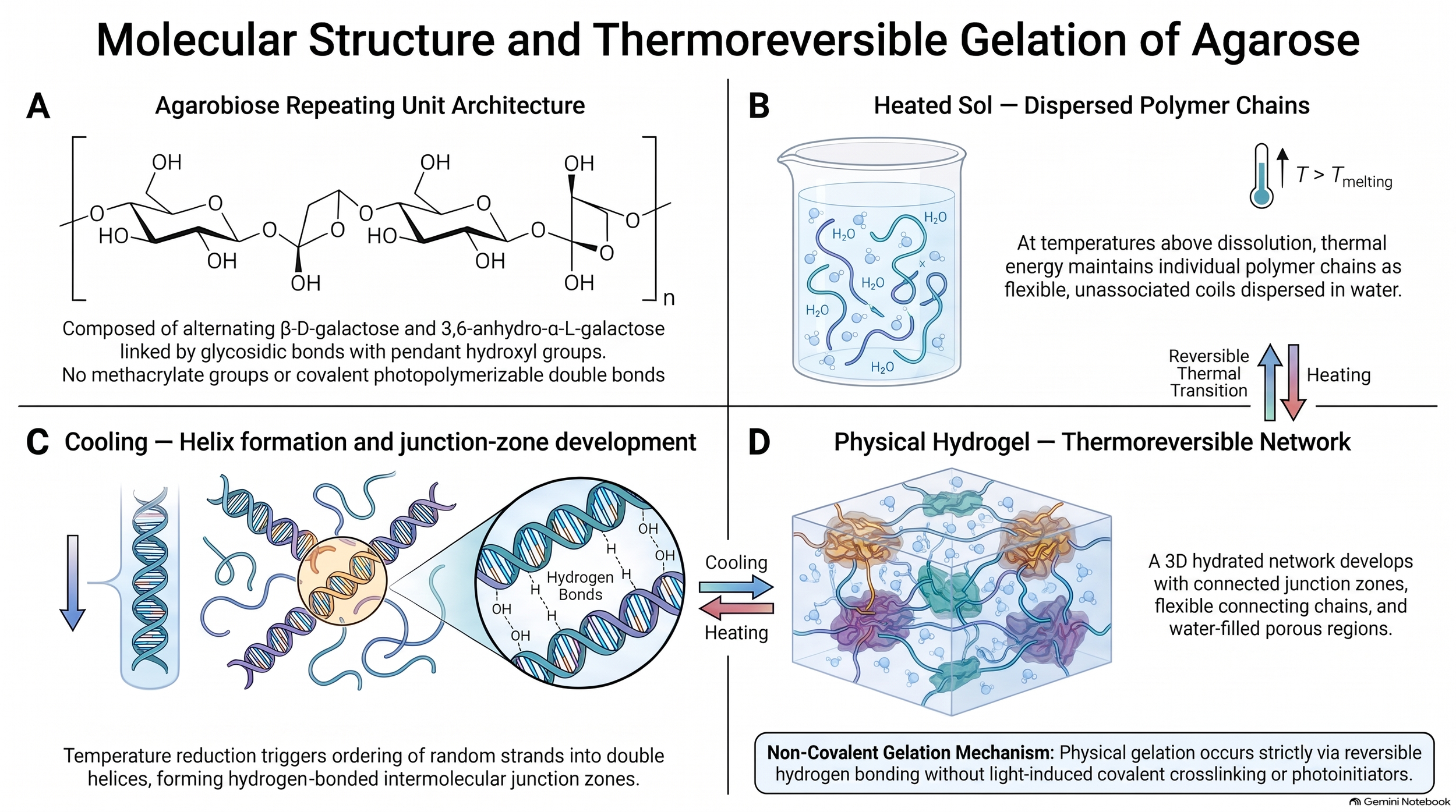
Figure 5 - The molecular organisation and thermoreversible gelation of agarose, illustrating how its physical network develops through temperature-dependent polymer associations.
The paper investigates the difference between physical gelation and photochemically induced network formation.
Conventional photopolymerisation-based CAL requires a material response that is linked to the projected light distribution.
Agarose's natural gelation mechanism does not automatically provide that response.
This is one of the most significant questions identified in the research, and one that will require experimental investigation.
The paper also considers how the optical properties of polysaccharide-based materials may be influenced by their wider composition and microstructure.
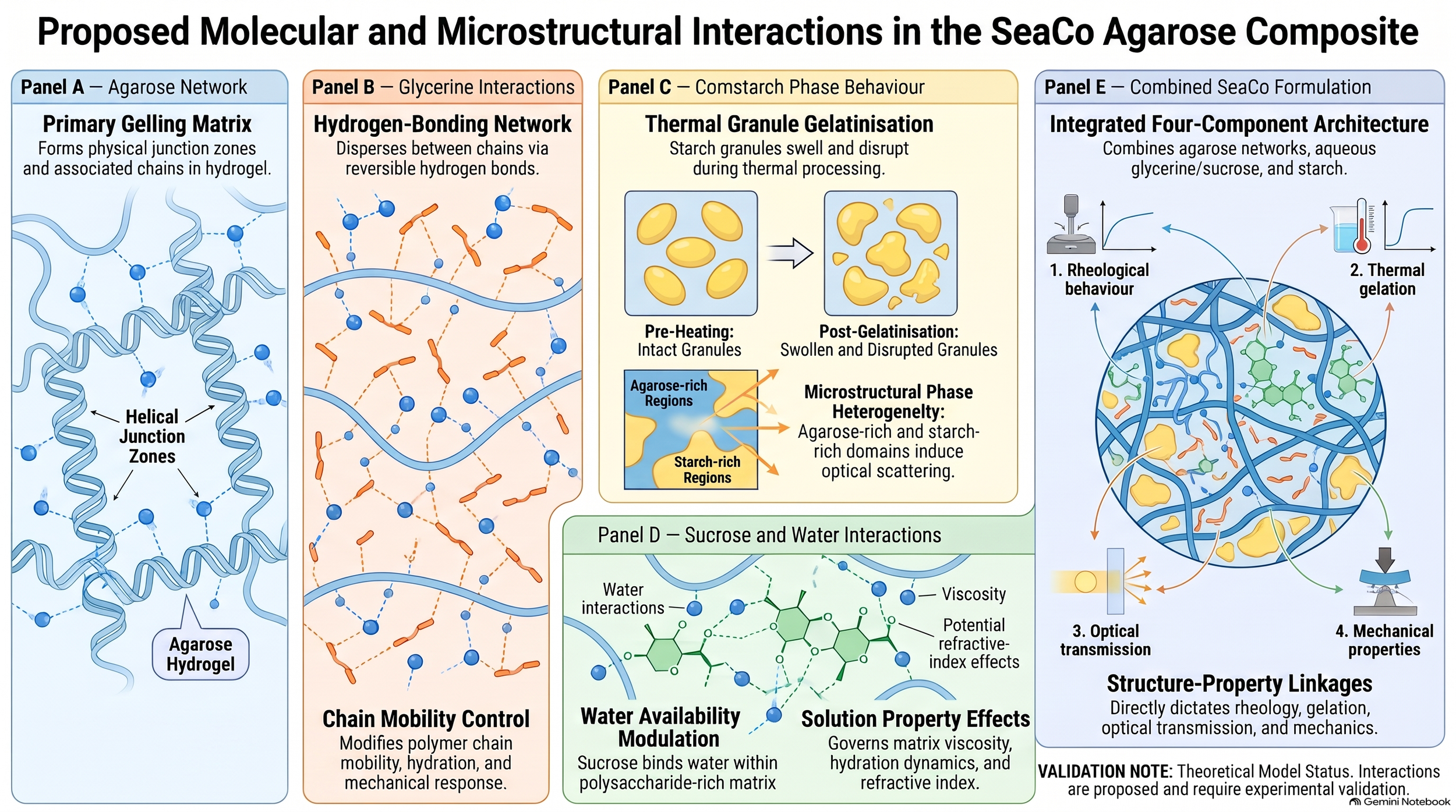
Figure 6 - A conceptual illustration of how absorption, scattering and material heterogeneity can influence light propagation through agarose-based composite systems.
Even a formulation that appears visually uniform may have optical behaviour that needs careful characterisation.
For a technology that depends on delivering controlled light throughout a three-dimensional volume, those details matter enormously.
What did the research actually establish?
Perhaps the most valuable outcome of this paper is not a single preferred chemical or a definitive material recipe.
It is a clearer understanding of the scientific questions that need to be answered.
The investigation establishes that curcumin and riboflavin are scientifically relevant candidates for further visible-light photochemical study, but neither has yet been validated as a suitable photoinitiator in the proposed SeaCo material.
It also demonstrates why optical absorption, photochemical reactivity and polymer network formation must be assessed as connected processes rather than separate material properties.
The computational investigations provide a foundation for examining these relationships and identifying the experimental evidence needed to move forward.
And, crucially, the research highlights the difference between a promising theoretical mechanism and a demonstrated manufacturing process.
There is still work to do.
Quite a lot of work, actually.
What about sustainability?
Sustainability is one of the main reasons SeaCo is interested in exploring alternative material systems.
Marine-derived polysaccharides offer an interesting starting point for investigating renewable material sources.
However, using a naturally derived ingredient does not automatically make a complete 3D-printing material sustainable.
The full picture also includes chemical processing, additives, energy consumption, manufacturing efficiency, material recovery and end-of-life behaviour.
A genuinely more sustainable manufacturing system needs evidence across its lifecycle, not simply a list of ingredients that originated in nature.
That is why our research considers material performance and environmental responsibility as connected objectives.
So, what happens next?
The next challenge is to move from theoretical investigation towards experimental evidence.
That means understanding the relevant optical, physical and chemical properties of candidate materials, investigating how they respond to controlled illumination and determining whether any resulting material changes are suitable for spatially selective manufacturing.
Only then can the computational predictions be compared with actual behaviour.
For now, this research represents an important stage in developing the scientific foundations of SeaCo's work.
It has helped identify promising areas of investigation, clarify fundamental limitations and establish the questions that future experiments must answer.
And that is exactly what good early-stage research should do.
The next chapter of the SeaCo research chronicles
What began as an interest in developing materials from seaweed has led into an unexpectedly fascinating intersection of photochemistry, computational modelling and advanced manufacturing.
We are not announcing a finished volumetric-printing material, and we are certainly not claiming to have solved every challenge involved.
What we are doing is asking how these technologies might be approached differently, examining the science behind the possibilities and building a research foundation for what comes next.
Because sometimes innovation begins not with an answer, but with a question that turns out to be far more complicated than you expected.
And apparently, in my case, that means an ever-growing collection of research papers, molecular diagrams and computational models.
Welcome to the next chapter of the SeaCo research chronicles. 🌊🔬
About the research
This article is based on Computational Screening of Bio-Sourced Photoinitiator Systems for Agarose-Based Computed Axial Lithography at 405–470 nm, by Elizabeth H. Challoner, SeaCo Designs (2026).
The investigation is a literature-informed and computational study. Its modelling results are exploratory and do not constitute experimental validation of a CAL-printable SeaCo biomaterial.
© 2026 SeaCo Designs. All rights reserved.
